
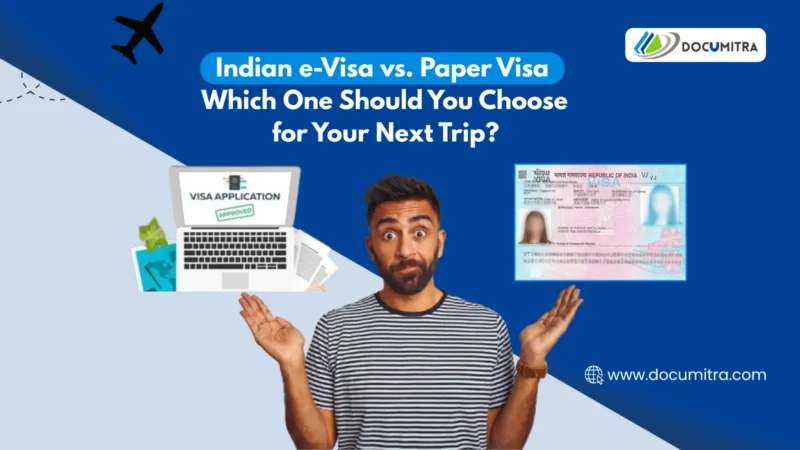
As global travel becomes more seamless and digital, travelers heading to India are often faced with an important question:
Should I go for an e-Visa or apply for a traditional paper visa?
The answer depends on a few key factors—your purpose of travel, duration of stay, and how soon you plan to fly. While both visa types offer legal entry into India, they serve different needs and come with unique advantages.
Here’s a comprehensive look at both, so you can make an informed choice before packing your bags.
What is an Indian e-Visa?
An e-Visa is an electronically issued visa that can be applied for and received entirely online—no consulate visits, no mailing of documents. Once approved, the visa is sent to your email as a PDF, which you simply print and carry with you when you travel.
Application Process:
- Apply on the official Indian e-Visa website
- Fill out the online form with your passport and travel details
- Upload required documents (passport bio-page, a recent photo, etc.)
- Pay the visa fee using a secure online portal
- Receive your e-Visa via email, typically within 24 to 72 hours
Who is it for?
- Tourists visiting for leisure or sightseeing
- Business travelers attending meetings, expos, or short-term projects
- Travelers seeking short-term medical treatment
Pros:
- Entirely online—no need to visit an embassy
- Fast turnaround (often within 3 working days)
- Less paperwork and no need to submit your original passport
- Cost-effective for short trips
- Available to citizens of 160+ countries
Cons:
- Limited to specific visa categories (tourism, business, medical, etc.)
- Entry only allowed through designated airports and seaports
- Not ideal for long-term, study, or employment-based travel
- Typically single- or double-entry, not multi-entry for long stays
What is an Indian Paper Visa?
The paper visa is the more traditional form of travel authorization—a sticker or stamp placed inside your physical passport after processing by the Indian embassy or consulate in your country.
Application Process:
- Download and complete the visa application form
- Submit supporting documents (e.g., passport, photos, travel itinerary)
- Book an appointment (if required) and visit the Indian consulate
- Submit biometric data (for some categories)
- Receive your passport back with the visa stamp once processed
Who is it for?
- Travelers planning a long-term stay (more than 180 days)
- Individuals applying for work, study, research, or residency visas
- Those needing multi-entry access or visas not covered under the e-Visa category
Pros:
- Broader range of visa categories available
- Can be valid for long durations (6 months to 10 years)
- More flexible on entry points, including land borders
- Ideal for frequent or long-term travelers
Cons:
- Longer processing time (5–15 business days or more)
- Requires more paperwork and sometimes in-person appointments
- May involve additional service charges or courier fees
- Physical passport submission is mandatory
At a Glance: Key Differences
So, Which One Should You Choose?
Go for an e-Visa if:
- You’re traveling for tourism, business meetings, or short-term medical needs
- You need to travel on short notice
- You want a quick and convenient application process
- You plan to enter through a major Indian airport or seaport
Choose a Paper Visa if:
- You’re staying for longer than 180 days
- You’re traveling for work, study, research, or as a dependent
- You need a multi-entry visa for frequent travel
- You plan to enter India via a land border
Let Documitra Help You Decide
Navigating visa options isn’t always straightforward. Every country has its own eligibility rules, processing times, and entry conditions—and India is no exception. That’s where Documitra comes in.
We help you evaluate the right visa type based on your purpose of visit, travel urgency, and documentation. Whether it’s a fast-track e-Visa or a more complex paper visa process, we guide you every step of the way—from form-filling and document checks to submission and final approval.
Our goal? To make sure your journey to India starts stress-free, with zero surprises along the way.


